
The Hebrew Month of Shevat | Unlocking Redemption and Divine Instruction
The Hebrew month of Shevat carries a powerful connection between humanity and the Torah—God’s instruction. It is a season to develop godly habits and patterns that shape the character required for the promotion God has prepared for you.
During Shevat, prepare for God’s hand to rest upon you as He teaches you how to live out the truth of Yeshua’s prayer in John 17:16-18. Though you live in a broken world, you are not of this world.
Yeshua prayed, “Sanctify them by Your truth. Your word is truth.” During the Hebrew month of Shevat, the Father is doing just that–bringing clarity and instruction through His Word so you can engage with people and circumstances from a place of purity and alignment with Him. Now is the time to incline your ear to His voice as He leads you into restoration and redemption!
Prophetic Quickview of Shevat
Shevat is a month of unlocking redemption and divine instruction that leads to restoration!
- The tribe associated with Shevat: Asher, Asher’s land was rich and abundant, full of olives, creating a flow of oil like a spring.
- The Hebrew letter associated with Shevat: Tzaddik, tzaddik is related to righteousness and righteous vigilance.
- Seek God’s instruction
- Embrace God’s instruction
- Understand there is a process of learning and imprinting God’s instruction on your heart
- Live a pattern of integrity, truth, and justice
- Prepare to break free from what has enslaved you and see the redemption of what has been weak
- See how God’s instruction helps you mingle with the masses, but also maintain spiritual maturity
- Honor and discover more about Tu BiShvat (the 15th), a day when the earliest trees begin to bud, promising what is to come–restoration!
Moses and Divine Instruction
According to Deuteronomy 1:3-5, on the first day of the Hebrew month of Shevat, one month before Moses died, he began his final explanation of all that God had given him to instruct the children of Israel.
“Now it came to pass in the fortieth year, in the eleventh month, on the first day of the month, that Moses spoke to the children of Israel according to all that the Lord had given him as commandments to them, after he had killed Sihon king of the Amorites, who dwelt in Heshbon, and Og king of Bashan, who dwelt at Ashtaroth in Edrei.
“On this side of the Jordan in the land of Moab, Moses began to explain this law, saying…” –Deuteronomy 1:3-5
It was Israel’s fortieth year in the wilderness, and the moment to enter the Promised Land was drawing near—though Moses himself would not cross over with them (Deuteronomy 1:3; 34:4).
Moses passed away on the seventh of Adar (Deuteronomy 34:5–7), the month following Shevat, and the children of Israel crossed the Jordan on the tenth of Nisan (Joshua 4:19), the month after Adar.
The teaching, explanation, and impartation that began on the first of Shevat marked the culmination of a forty-year journey. It was a final season of preparation, equipping the people to step into and take possession of what God had promised to Abraham (Genesis 12:7; 15:18).
For Moses, this moment was paramount.
- He had led the Israelites out of Egypt after the Ten Plagues.
- He had received and delivered the Ten Commandments.
- He had led and loved this nation for 40 years.
The Promised Land was in sight for the children of Israel, but ultimately, Heaven was in sight for Moses.
This moment–this Hebrew month of Shevat–must have felt like a culmination, his final opportunity to impart instruction.
According to the *Talmud, Moses gave this final explanation in 70 languages to reach the hearts of the nation, which now included more than 600,000 men (Numbers 26:51).
From a human perspective, it is difficult to imagine how this was possible. Moses likely used other men to help communicate and translate the instruction. His desire was to make God’s teaching accessible to everyone, without exception—so that all could understand, receive, and embrace God’s best for their lives.
Moses understood that to possess the Promised Land, the children of Israel needed to live in alignment with God’s covenant promises and instructions. They could not forget what God had spoken to them in the wilderness.
*The Talmud is the central text of Rabbinic Judaism. It is often full of commentary and “saying the unsaid.” Although it is not inspired, it remains a valuable historical document.
Highlights vs. the Middle
As Believers, we often focus on the highlights of biblical stories and forget what it must have been like to live in the middle of them.
We celebrate Passover as a moment of victory and deliverance—but imagine being part of the families who left Egypt only to face a wilderness and a life of complete dependence on God to meet their daily needs. Passover was a climactic moment, yet the days surrounding it were filled with pressure that positioned the Israelites exactly where God wanted them.
The same is true of crossing the Jordan into the Promised Land after forty years. It was incredible. It was miraculous. But the Israelites did not enter a land of instant peace. After Moses’ death, the people were required to dispossess the land before they could possess it. They had to contend for what God had already promised them. Once again, pressure became the means of positioning.
- “…you shall dispossess the inhabitants of the land and dwell in it, for I have given you the land to possess.” —Numbers 33:53-54
With all this in mind, enter the Hebrew month of Shevat with a listening heart, attentive to divine instruction, just as it was necessary for Israel. The wisdom given to them during Moses’ final days served as a vital reminder of how they were to live in order to possess the land and the promise.
You may feel like you have been wandering in a desert for 40 years–or faithfully reading the Word of God for decades and still feel “in the middle.” Yet, in the month of Shevat, listen with fresh ears and a heart ready to receive. God is preparing you to cross over your Jordan, with His instruction firmly imprinted on your heart and mind.
Something is shifting. You can sense the transition. As you move forward, remain rooted in your true identity—one that is not shaped by feelings or circumstances, but anchored in who God says you are.
The Hebrew Letter Tzaddik & Numerical Value 90
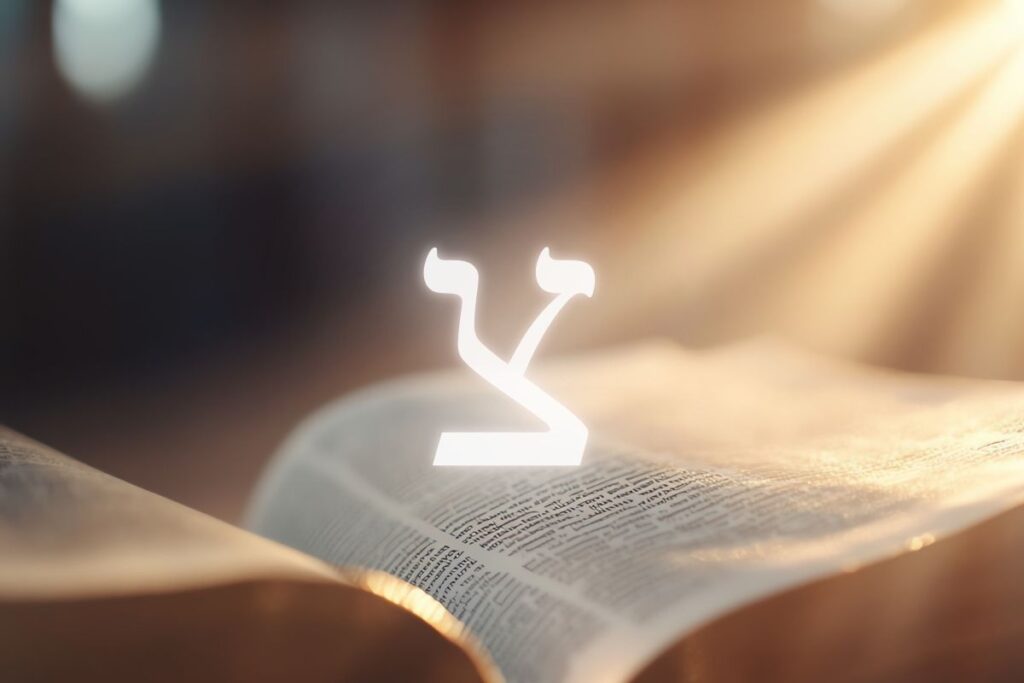
The Hebrew month of Shevat is connected to the Hebrew letter Tzaddik.
The word Tzaddik comes from the Hebrew root tzade–dalet–kuf, which means “righteous, just, or aligned with what is right.” It reflects both the righteousness of our Creator and a person who lives in alignment with that righteousness. A tzaddik emulates God’s character by walking in integrity, truth, and justice.
This pattern of disciplined living is something we pursue throughout our lives. Even as our bodies weaken with age, our spirits continue to grow stronger as we deepen our pursuit of righteousness.
In Matthew 6:33, we are instructed to “seek first the kingdom of God and His righteousness…” I love what Curt Landry says about this principle in his book Reclaiming Our Forgotten Heritage:
- “…He [Yeshua or Jesus] was telling them [those who were at the Sermon on the Mount] to seek first the kingdom of God and His justice—His fairness—hence the Jewish tradition of giving tzedakah, which is the giving of financial alms or aid and assistance to the poor, the needy, or those who have been denied justice. It’s literally doing things that facilitate empowerment, equality, and freedom for all. Seeking his righteousness is an active action of promoting social justice on the earth, not just keeping rules and performing as Christians.” (page 133, emphasis added)
Isaiah 3:10 says:
- “Say to the righteous that it shall be well with them, for they shall eat the fruit of their doings.”
In other words, say to those who choose to walk in the ways of the Lord and to those who seek justice, “You will reap what you sow.”
Reset Your Lifestyle in the Hebrew Month of Shevat
Seeking first the Kingdom of God and His righteousness is a lifelong journey that draws you closer to His heart. It is a way of living shaped by daily choices. And while it is a pursuit worth embracing, it is not without missteps. Some days you will feel like you truly lived it well; other days, not so much.
On the “not-so-much” days, we repent and return.
God’s instruction is given as an opportunity for blessing. While there are *613 instructions in the Torah, they are not burdensome or disconnected. They are woven together through the call to love God and love your neighbor (Matthew 22:36–40). Each instruction stands on its own, yet all are united and ultimately expressed through the Ten Commandments.
Redemption
The Tzadik is one of the 5 Hebrew letters that takes on a different form when placed at the end of the word. These letters are known as “sofit” letters or “final form” and represent the concept of redemption or culmination.
Redemption comes after a period of enslavement. The ultimate redemption given to us is by the Messiah and truly is the culmination of our faith.
- “Also your people shall all be righteous; they shall inherit the land forever, the branch of My planting, the work of My hands, that I may be glorified.” —Isaiah 60:21
In the Hebrew month of Shevat, Moses began to prepare the Jewish people to enter the Holy Land, Eretz Yisrael. He began to prepare their hearts and their minds with instructions.
It wasn’t just rules—it was the guidelines and boundaries that God had set to keep His people in a covenant relationship with Him, reminding them to stay true to their identities.
These instructions were designed to keep them close to His heart and not lose themselves in the cultures of the land they were meant to possess and transform.
I imagine, at this moment, it was as if God was saying through Moses, “Do not forget who you really are.”
As this generation began to take possession, it was a form of redemption for which the initial steps and preparation began. Therefore, we see the Hebrew month of Shevat as a precursor to what is to come.
*In Hebrew, each letter has a corresponding numerical value. The numerical value of the Hebrew word tzitzit, the fringes on the corners of the tallit, is 600. When you add in the 5 knots and the 8 threads of the Tzitzit, the total is 613, which is thought to be symbolic of the 613 instructions in the Torah. This is why we wrap the tzitzit around our fingers. It is symbolic of us fully embracing and being embraced by God’s Word.
Trees of Righteousness
- “…for the tree of the field is man’s food.” —Deuteronomy 20:19
In Judaism, the Hebrew month of Shevat celebrates the New Year for trees. This holiday is celebrated on the 15th and is called Tu BiShvat. On this day, the earliest trees begin waking up from their winter slumber. They bud for spring and the promise of what is to come.
Throughout scripture, there are many connections between humanity and trees.
- In Isaiah 61:3, those who mourn in Zion are called “trees of righteousness.”
- Jesus, the Messiah, was called the Branch, which often referred to the connection between Jesus and His physical descent as a son of David–a connection to His humanity (Isaiah 4:2, Isaiah 11:1).
Trees remain a central part of our faith journey when we consider the:
- Tree of Life
- Tree of Knowledge
- The Cross
And as One New Humanity, being “grafted into the olive tree” (Romans 11:24-25) is a foundational pillar of our faith and culture.
The Hebrew month of Shevat marks a fresh start and an opportunity for us to live as trees of righteousness–as men, women, and families who embrace the Tree of Life and live in light of the Cross–grafted into our true covenant identity.
Shevat is an opportunity to embrace redemption and new life.
Oil and Water and the Tribe of Asher
The Hebrew month of Shevat is connected to the tribe of Asher. When Jacob blessed Asher, he said:
- “Bread from Asher shall be rich, and he shall yield royal dainties.” —Genesis 49:20
The rabbis teach that this blessing means that the food from Asher’s land will be very rich, and an abundance of olives will grow in his territory, where the oil will flow as if from a spring.
When Moses blessed Asher, he said:
- “Asher is most blessed of sons; let him be favored by his brothers, and let him dip his foot in oil. Your sandals shall be iron and bronze; as your days, so shall your strength be.” —Deuteronomy 33:2, 25
The Talmud recounts a story about Asher’s land being so abundant in olives that one member of the tribe was able to provide an astounding amount of oil to a gentile purchaser.
According to this story, the people of Laodicea, the home of the lukewarm church, needed oil. They appointed a gentile messenger to search for it. He went to Jerusalem, Tyre (a commercial city), and finally, Gush Halav, an area within the portion given to Asher. Here, he found an abundance of olive oil to meet his needs.
In Judaism, olive oil is associated with wisdom, and the Torah refers to it as water (necessary for life itself). Therefore, the tribe of Asher was blessed with an abundance of the commodity of oil, representing wisdom.
Shevat is associated with oil and water, as well as spiritual principles. The true application of God’s instruction involves mingling with the masses while maintaining spiritual maturity.
Fresh Outpouring
During the Hebrew month of Shevat, the children of Israel experienced the second giving of the law and a fresh outpouring of God’s instruction, the ultimate form of wisdom. It is believed to be a time when instruction, understanding, and wisdom are presented from Heaven for the entire year ahead.
But for us as Believers to serve as vessels of divine instruction, we must be able to understand its wisdom. We must possess both oil and water, emulating the qualities of both, as we are able to mix and mingle with the world, yet remain uncorrupted by its influence.
We must remember our true identity as we walk into our own Promised Land in this next season.
- Do not forget the last 40 years in the wilderness.
- Do not forget the miracles.
- Do not forget the instructions.
- Do not forget the generations before you.
Remember who and Whose you are as you cross the Jordan River and enter into what God has for you.
Shevat is a season to prepare your heart for transition.
Redemption of Weakness
The Father gave Moses the gift of speaking His instructions to an entire generation so that he, who was “slow at speech,” became the conduit for divine teaching. His weakness became his strength. He allowed God to use what he had and made himself available–imperfections and all.
Sometimes I think about the opportunities I may have missed when I only focus on what I can do well instead of simply yielding what was in my hands and allowing God to transform it into a tool for His Kingdom.
We need divine inspiration to adopt, understand, and embrace the example that Moses left us and apply the teaching he presented.
- “You shall teach them diligently to your children, and shall talk of them when you sit in your house, when you walk by the way, when you lie down, and when you rise up. You shall bind them as a sign on your hand, and they shall be as frontlets between your eyes. You shall write them on the doorposts of your house and on your gates.” —Deuteronomy 6:7-9
During Shevat, we are presented with an opportunity to embrace instruction and thereby use obedience to the Word of God to repair the destruction of disobedience brought on by the Fall in the Garden, when the serpent enticed Adam and Eve to choose knowledge over obedience.
During Shevat, we are to attempt to embody the Righteous One Who is the foundation of the universe, and be vessels that host His holiness and presence even in the midst of our own imperfections.
We continue to seek after, hunt after, and pursue His justice.
Key Takeaways for the Hebrew Month of Shevat
There are many takeaways from the Hebrew month of Shevat, but the thread that is woven throughout is this: redemption and restoration.
God gave us His instruction to redeem us. We were redeemed for relationship and restored to the Father through Yeshua.
The tree of life, the cross, and the olive tree, into which we are grafted, represent the redemption of humanity.
Embracing God’s wisdom is the true redemption from Adam and Eve’s choice – to rely on their own strength and understanding instead of trusting God.
When we embrace God’s wisdom daily and choose faith over knowledge, we break that pattern. We are embracing the best that God has for us.
Prayer for Shevat
Our prayer for you during the month of Shevat:
May you hear and embrace God’s wisdom and instruction so that you can walk in the promises God has for you this year. May you know your true identity that is fully rooted in Him as one who has been redeemed and is a new creation–part of One New Humanity. May you seek justice and God’s righteousness in every decision you make, and may you live like oil and water—mingling with the world to transform it but remaining pure and true to who you have been called to be in holiness. May you live as one who has been redeemed and seek the redemption of others.